


Hi there! How can we help you today?
How Responsible AI Is Helping SPACEUG Turn Threat Reports into Faster, Human-Led Protection
-
Home
-
Project News
-
How Responsible AI Is Helping SPACEUG Turn Threat Reports into Faster, Human-Led Protection

How Responsible AI Is Helping SPACEUG Turn Threat Reports into Faster, Human-Led Protection
Every report on SPACEUG comes from a person who has been threatened, detained, followed or silenced, or who has watched it happen to someone else. Behind each submission is a journalist, a lawyer, a community activist or a civil society worker who decided that writing it down was worth the risk. Our job is to make sure that decision leads somewhere.
Today we are publishing the SPACEUG Threat Monitoring and Referral Tool: Implementation and Impact Report. It explains how we added artificial intelligence to SPACEUG in 2026, what the platform recorded between May and 31 October 2026, and what we learned about using AI in work where a mistake can put someone in danger.
[Download the full report (PDF)]
Why we had to change how we handle reports
Human rights defenders, journalists and civil society organisations in Uganda work in a tight space. The CIVICUS Monitor rates Uganda's civic space as "repressed." In January 2026, days before the general elections, the NGO Bureau suspended ten civil society organisations, including human rights, media and election-monitoring groups. For people in rural and underserved areas, recording an incident and finding the right help is harder still.
We built SPACEUG's threat reporting tool at threat.spaceug.org to give these people a safe, private way to document what happens to them and get referred to protection actors. As more reports came in, our team hit a practical wall. Each submission had to be read, assigned to the right regional case officer, checked for urgency and compared against what had already been published about the incident. Reports arrived in different languages. Urgent cases could sit in the queue behind routine ones.
Collecting more reports would not fix that. We needed each report to reach the right person faster, with better information attached.
What we built
With support from the NetHope Connected Artificial Intelligence Grant, made possible by Microsoft Elevate, we added four functions to SPACEUG:
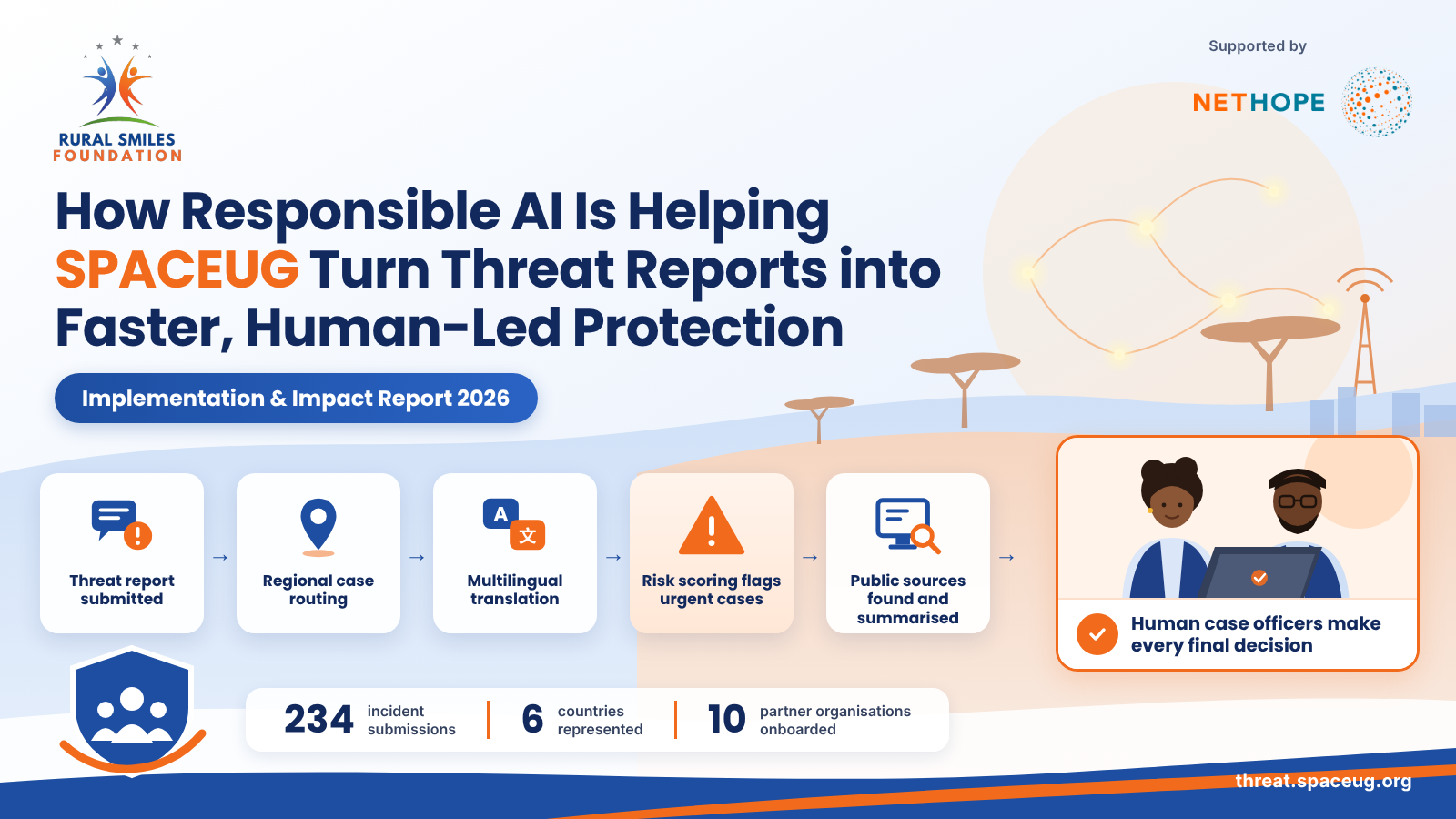
- Automated regional case routing sends each incident to the case officer responsible for the location where it happened, so nobody has to sort reports by hand.
- Multilingual translation lets case officers read and process reports written in different languages.
- Risk scoring flags reports that may be urgent or high-risk so a person can look at them first.
- Information retrieval and summarisation searches publicly available online publications for coverage of a reported incident and summarises what it finds, giving case officers more to work with when they verify and assess a case.
None of these tools makes a decision. A case officer still reviews every report, judges its credibility and decides what referral or protective action to take. The AI shortens the path to that decision. It does not replace it.
How we did it
We started with the problems our case officers described and designed each function around them. We then demonstrated the improved platform to 15 civil society representatives through the Kitara Civil Society Organizations Network and asked them about usability and case management. Their feedback shaped the final version, and 10 partner organisations joined the platform during this stage.
After deployment, we trained our staff to use the new functions responsibly and adopted Rural Smiles Foundation's Artificial Intelligence Policy to guide how we use AI across our work.
What the reports showed
Between May and 31 October 2026, SPACEUG recorded 234 incident submissions from six African countries. Uganda accounted for 193 of them (82.5%). The other 41 came from Kenya, Tanzania, South Sudan, the Democratic Republic of the Congo and Rwanda.
The submissions describe arbitrary detention, intimidation, restrictions on peaceful assembly, judicial harassment, censorship, digital repression and threats to community rights. In Uganda, the detention of lawyers and civic activists and restrictions on media stood out. In Kenya, our assessment covered arrests, reported disappearances and movement restrictions around the 25 June 2026 demonstrations. In Tanzania, we noted restrictions on political gatherings, arrests and terrorism-related prosecutions in June and July, followed by new limits on independent media in August.
The harm rarely stops with the person targeted. Families lose income. People cannot reach a lawyer. Businesses close during protests. Others see what happened and stop speaking up. The June 2026 detention and deportation of a Kenyan lawyer from Uganda also showed how restrictions now cross borders, which is why regional monitoring matters.
What we learned
Context matters. Automated analysis has to account for local languages, political sensitivities and incomplete information. A risk score or a news search can support an assessment, but neither can prove that an incident happened. Human interpretation remains essential.
Protection comes first. Anonymity, restricted access and careful data handling are basic requirements when you document threats against people at risk. We tightened access controls and made safeguarding sensitive records part of every workflow.
Human oversight is essential. AI helps us prioritise and analyse information. Verification, protection decisions and referrals stay with trained people.
Technology alone did not make this work. It worked because our staff were trained, our processes were clear and the communities using SPACEUG trust us with their information. We intend to keep that trust.
What comes next
We will keep the AI functions running through ongoing maintenance, data protection, staff training and human-led case management.
Separately, Rural Smiles Foundation is working with CIVICUS through the Digital Democracy Initiative Civic Tech Lab project, Strengthening Regional Civic Space Monitoring and Protection in East Africa. That project is improving SPACEUG's security, usability and reporting workflows and supporting its planned expansion into Kenya and Tanzania.
We want to work with civil society organisations, human rights defenders, journalists, legal aid providers, digital security specialists, research institutions, technology organisations, diplomatic missions, United Nations agencies and development partners who share this goal. If you can help strengthen documentation, early warning or coordinated referrals in East Africa, we would like to hear from you.
Thank you
We thank NetHope Connected and Microsoft Elevate for supporting the AI enhancements, CIVICUS for supporting SPACEUG's continued development and regional expansion, the Kitara Civil Society Organizations Network, and every civil society organisation, technical contributor and community member who tested the platform and told us what needed to change.
Read the full report: [Download the PDF]
Share this post:
Related Posts
Project News Rural Smiles Foundation Holds Consultative Meeting with Local Leaders to Co-Create Community Peace Solutions
Project News Advancing Inclusive Democracy in Rural Uganda: Rural Smiles Foundation Launches Community Participation Initiative in Kibaale